

During our last show, I mentioned I’d had the chance to spend some quality time with the Walther PPX. The PPX is Walther’s “budget” or “entry-level,” full-size pistol. Unlike it’s more expensive Walther stable mates, it is slide-cocking and hammer-fired, with a short double-action-only trigger stroke reminiscent of HK’s Law Enforcement Modification (LEM) except that it lacks double-strike capability normally associated with DA/DAO triggers. The PPX is a full-size, clunky-looking pistol that might remind you of a Hi-Point. In fact, Joe Grine, of The Truth About Guns, went so far as to say he thought it was a “freakin’ Hi-Point,” at first glance. I can’t say I blame him.
 When you see it next to a Glock 17, the PPX’s bulk is quite noticeable. The slide is very tall, giving the gun a very high bore-axis. A high bore-axis contributes to more felt recoil and longer recovery times between shots if all other variables are equal. In addition to resembling a large metallic brick, the PPX’s slide construction is reminiscent of early SigSauer P-series pistols. It has a breech-block containing the extractor, firing-pin, and firing-pin safety plunger that is secured to the slide via transverse roll-pin. The PPX manual makes no mention of servicing these components beyond the external application of a drop of lubricating oil. Walther apparently does not plan for PPX owners to do much in the way of shooting, let alone maintenance on their guns.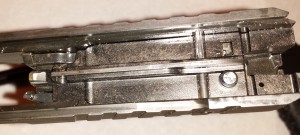
The grip, in spite of appearances to the contrary, fits the hand well and houses a 16-round magazine. The “hump” actually fills your palm and the texture provides good traction without being rough. Unlike the P99 and PPQ, the PPX does not offer anything in the way of adjustments of the grip size/circumference for individual users. Its grip is one size fits most in no small part because this gun is built to meet a price point below its stable mates at Walther. Specifically, the P99 and PPQ. One adjustable feature the PPX does offer is a user reversible magazine catch. The slide stop lever is easy to reach with the dominant thumb for right handed shooters and South-paws, with a little effort, could manipulate it with their index finger. The take-down lever works in a manner similar to Sigs, M&Ps, and other pistols in that one must lock the slide to the rear, turn the take-down lever clock wise, and then release the slide to remove it from the gun.
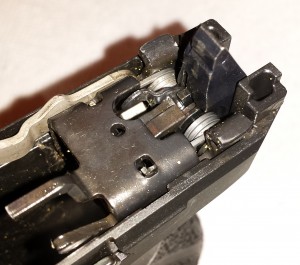 As mentioned earlier, the PPX is hammer fired with a DAO trigger. There is no decocker or manual safety. It functions similarly to Hechler & Koch’s “Law Enforcement Modification” (LEM) with a two-piece hammer but, it’s not a true DA/DAO trigger. After the hammer falls, the trigger cannot cock the hammer or trip the sear. The hammer must be cocked by the slide and the trigger bar itself serves as the disconnector for semi-automatic operation. Those oddities aside, the benefit of this system for the shooter is a consistent trigger stroke from the first shot to the last. The trigger moves smoothly to the rear with minimal effort though the pre-travel stage where you meet a stated 6.5lbs of resistance necessary to engage the sear. Trigger movement through sear engagement to hammer release represents less than an 1/16th-inch of travel with over-travel being another 1/8th inch or so after the break. To reset the trigger, you need only allow your finger to move forward 3/8ths-inch but, you can clearly feel the trigger catch the link to back on the sear and fire again quickly.
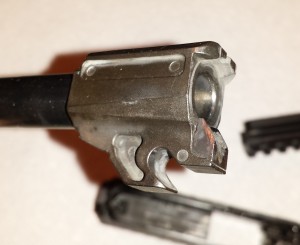 Another oddity I noticed with this pistol is the barrel assembly. I specifically call it an assembly because unlike most pistol barrels machined from a single forging, it’s a three piece unit. Yes, three separate pieces. The largest is bore itself that does seem to be turned from a forged barrel blank. The second piece appears to be a metal injection molded, or possibly cast, shroud around the chamber area that makes up the barrel hood as well as upper/lower lugs. And finally, there’s a feed ramp that may be a stamping, fitted to the lip of the aforementioned shroud. How these pieces are affixed to each other isn’t really clear. They may be press fit and/or soldered but, I honestly can’t tell. TTAG, Joe Grine, asked Walther about this and they indicated that they employed this design because one-piece barrels tend to deform. The implication, it would seem, is that the one piece barrels that nearly everyone else uses are somehow inferior. I don’t know that I buy their argument as they don’t seem to apply it to the more expensive P99 or PPQ.
The copy of the PPX I’ve worked with has less than 2000 rounds through it. In that time, firing, extraction, and ejection have been reliable. Feeding it became a problem that I’ll expand on shortly. Accuracy good enough to hit a golf ball at 30 yards and ding a steel IPSC target out to 200 yards. Sights are crisp and easy to see. Being a 9mm, recoil isn’t significant but, the high bore-axis means it doesn’t shoot as flat a Glock 17, Smith M&P, or even a Springfield XD. Overall, the shooting experience is not a bad one. However, overall construction of the gun does not contribute to it’s longevity and that brings us to the feeding issue. With the magazine seated, the gun has thus far fed reliably. The problem we ran into on our most recent outing with the gun however, was that seating the magazine\ became a problem. What we found was that back wall of the magazine well is not a solid wall. It has three voids in it that are bisected by a ridge running down the center, forming a spine of sorts. This ridge developed a burr that imp eded the removal of a spent magazine and insertion of a new one. In an attempt to finish our workout for the day, we tried using a knife to scrape away this burr but, each new magazine threatened to raise another burr.
At the end of the day, the PPX is very much a “full-size” pistol. It is built to be cheap and it shows. Not quite as cheap as a Hi Point but, corners were obviously cut to meet a price point and the material of the magazine well is a corner cut in the wrong place. Walther didn’t build the PPX to be maintained beyond basic field stripping by the owner. And if you like the white dots in the factory sights, do not allow Gun Scrubber or any common gun solvent to touch the sights. Simply put, I don’t expect to see this gun “getting wood” in a major IDPA match or otherwise surviving a high volume class in which the owner might put over 1000 rounds through the gun in a weekend. This is a gun meant to be purchased, shot a few times for the sake of familiarity, and then put into storage with a hope it will never have to be used in anger. But at $450 retail, it’s still not all that cheap and to me, better options can be had for the same price or less on the used gun market.
-GM

